Fencing — Sunshine Coast
The boundary defines everything within it.
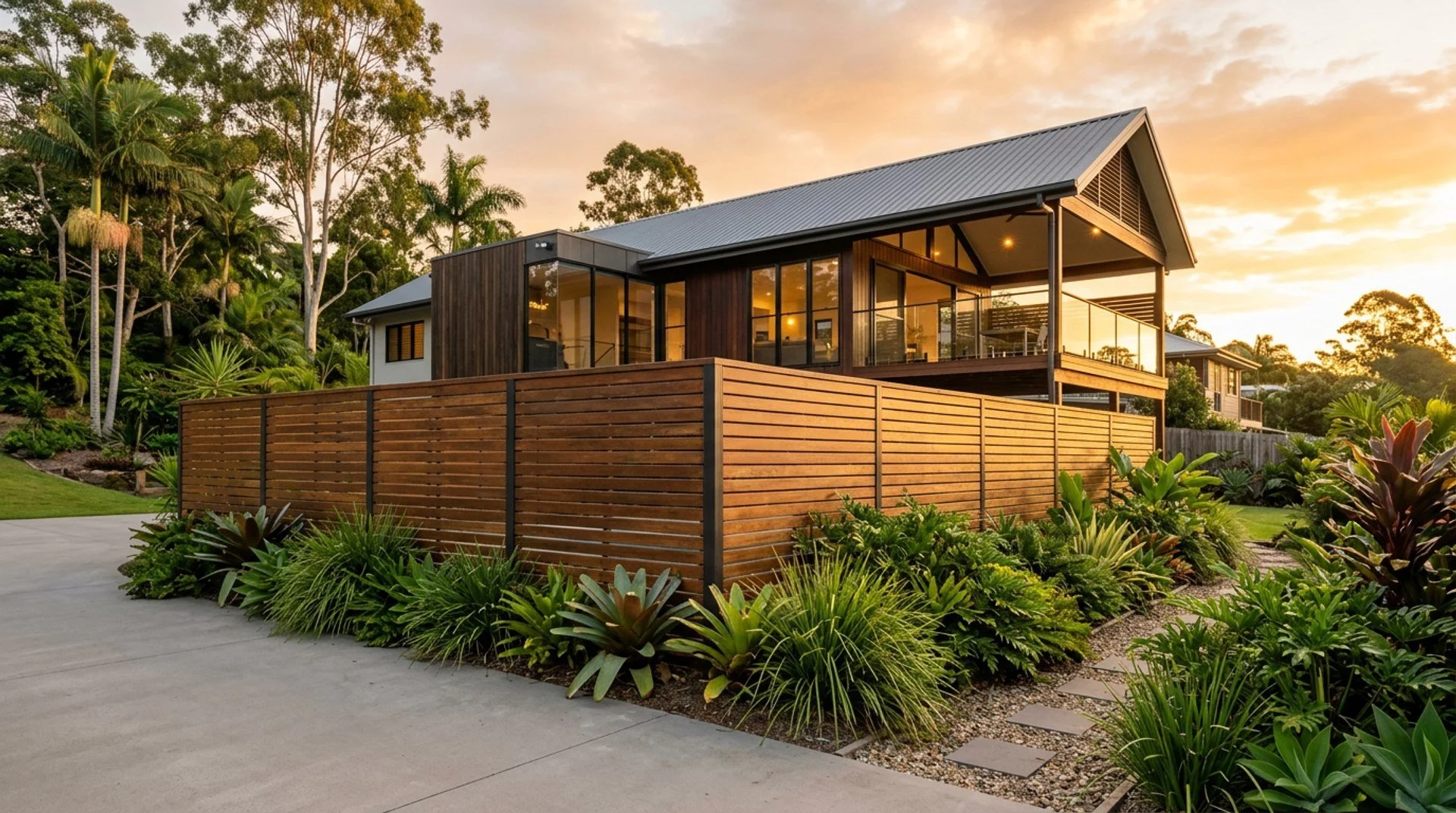
Fencing is the frame of the outdoor environment. Stone & Grain builds fences and gates in six materials — from Colorbond to Corten steel — selected for the site, the aesthetic and how long it needs to last.
A fence is the first thing people see and the last detail most builders get right.
Fencing does more work in a landscape than almost any other element. It defines the boundary, creates privacy, frames views in and out of the property, provides acoustic screening, and — in the case of pool fencing — must meet strict Queensland safety legislation. Get it wrong and no amount of quality landscaping inside the boundary compensates. Get it right and it becomes invisible: the confident frame around everything else Stone & Grain builds.
Stone & Grain integrates fencing into the broader landscape build — specified and installed as part of the outdoor environment design rather than as a separate contractor engagement. Post positions are coordinated with paving setouts. Gate positions are resolved with driveway levels and pedestrian flow. Materials are chosen to work with the house, the landscaping and the street — not selected from a standard range applied regardless of context.
In Queensland, dividing fences between neighbouring properties are governed by the Neighbourhood Disputes (Dividing Fences and Trees) Act 2011. Stone & Grain can advise on your obligations and coordinate the necessary neighbour notification process where required before construction begins.
FENCING MATERIALSSix materials. One honest breakdown.
Two fundamentally different approaches to decking — both built to a premium standard. The right choice depends on your site, your lifestyle, and how much ongoing interaction you want with the material.
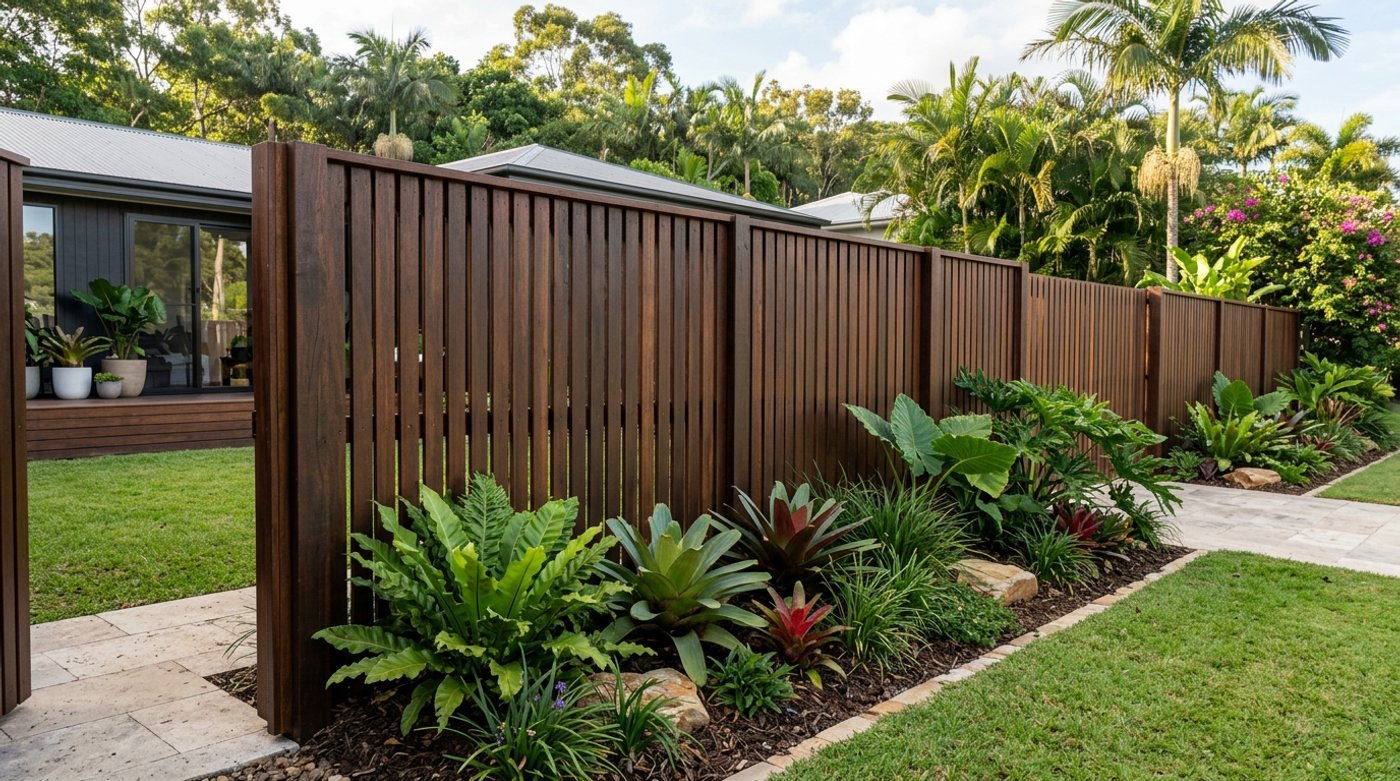
MERBAU · SPOTTED GUM · IRONBARK · BLACKBUTT · VERTICAL SLAT · PALING · FEATURE SCREEN
Hardwood Timber
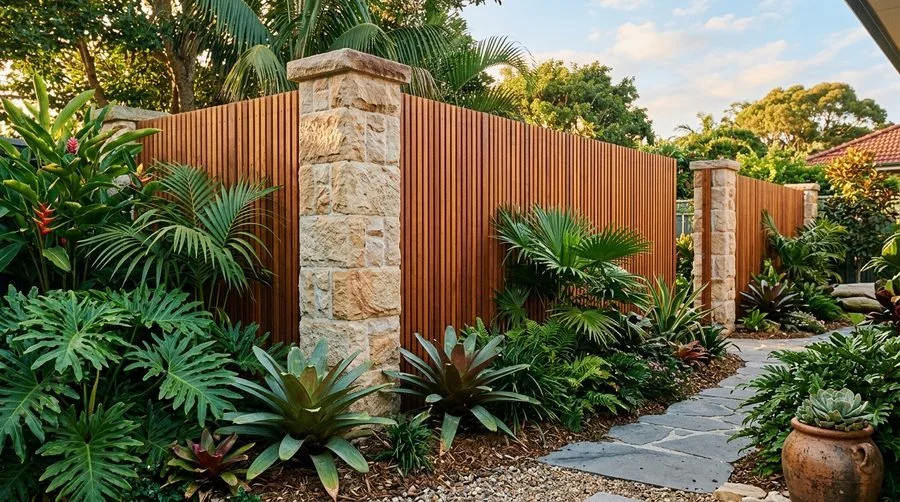
Hardwood timber fencing is the premium natural choice — warm, characterful and deeply suited to the subtropical Queensland environment. Oiled merbau or spotted gum palings or vertical slats sit naturally against the stone, planting and landscaping that surrounds them. Where a fence needs to be a design element — a feature screen, a garden room divider, a slatted privacy wall — hardwood is the material that makes it feel considered rather than functional.
ADVANTAGESRich natural warmth that integrates with landscape and planting
Hardwood species (merbau, ironbark) have 25–30+ year service life
Vertical slat format provides privacy while allowing airflow — critical in Queensland
Can be stained, oiled or left to silver naturally — multiple aesthetic options
Custom profiles and spacing available — not limited to standard paling widths
Pairs beautifully with stone cladding on posts and piers
CONSIDERATIONSRequires oiling every 12–24 months to maintain colour and protect the timber
Higher upfront cost than Colorbond or PVC
Post footings in ground-contact must use H4 or H5 treated timber or steel posts
Merbau tannins can bleed onto concrete and paving when new — allow for washout period
Some species have lead times due to supply variability
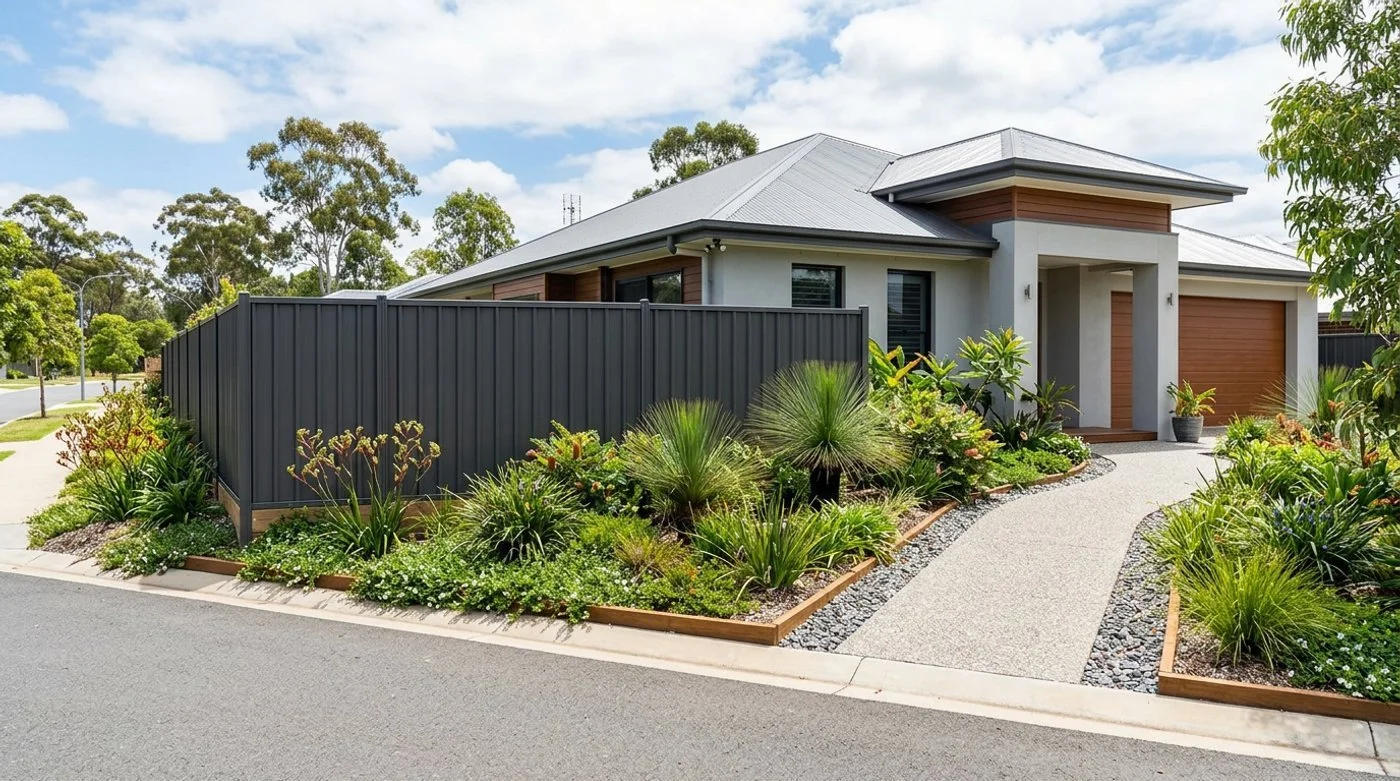
STANDARD · ULTRA · MONUMENT · WALLABY · SURFMIST · SHALE GREY · WOODLAND GREY · CUSTOM COLOURS
Colorbond Steel
Colorbond is the most widely installed residential fencing material in Queensland — and the reason is straightforward. It is durable, low maintenance, available in a range of colours that suit the regional palette, and correctly specified it will outperform almost anything else over a 25-year period. Stone & Grain installs Colorbond Ultra on all coastal and near-coastal properties where the marine grade steel provides significantly better corrosion performance. Post sizing and footing specification are matched to local wind loading requirements.
ADVANTAGESZero ongoing maintenance — no oiLowest maintenance of any solid fencing material — hose down occasionally, nothing more
Wide colour range — Colorbond palette includes warm neutrals that suit Queensland homes
Durable — 25+ year performance when correctly specified and installed
Colorbond Ultra provides marine-grade corrosion resistance for coastal properties
Consistent profile and colour — no variation between panels
Cost-effective for longer fence runs compared to timber or aluminium
CONSIDERATIONSLimited to the Colorbond standard colour palette — custom colours not available
Reads as a manufactured product — lacks the warmth of timber or the premium of Corten
Standard Colorbond is not rated for marine environments — Ultra must be specified near the coast
Dents are difficult to repair — a replacement panel is usually required
Less appropriate as a design feature — primarily functional
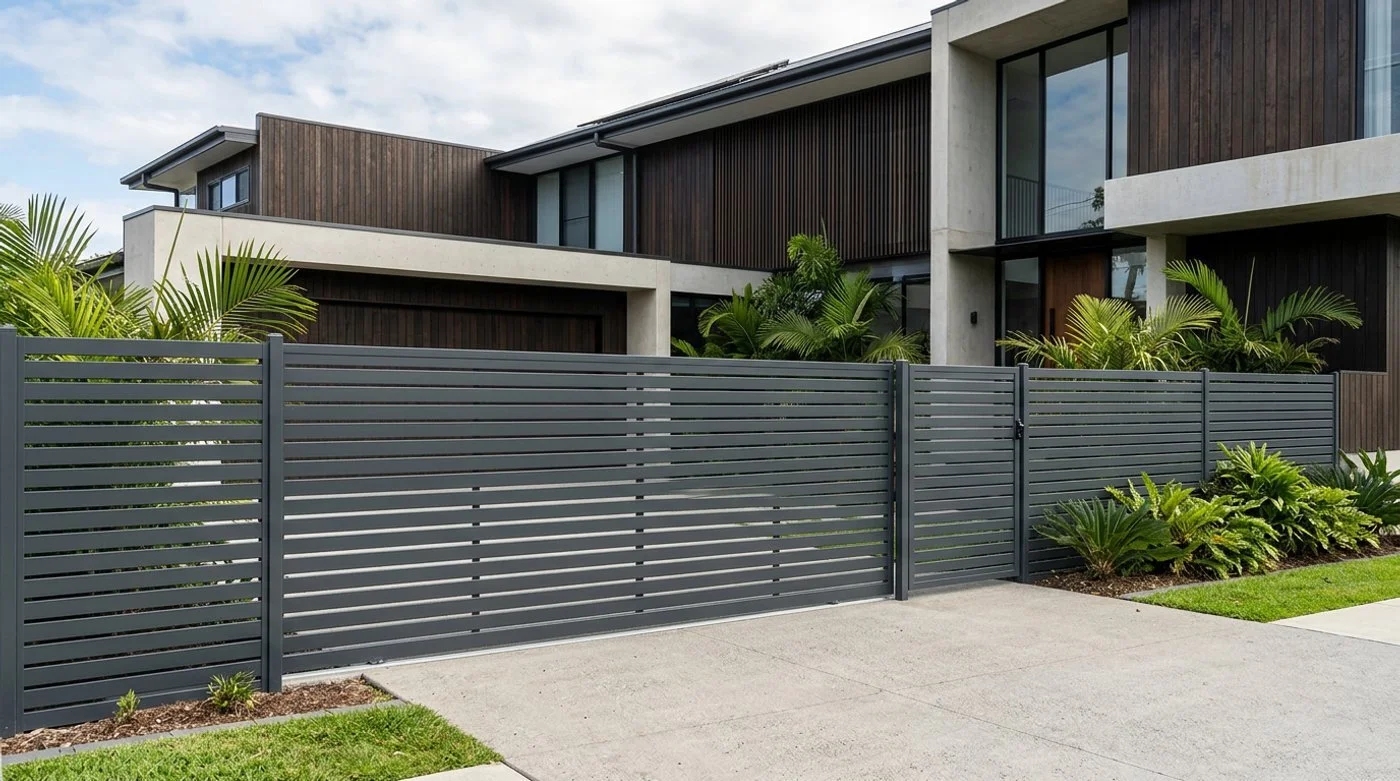
HORIZONTAL SLAT · VERTICAL SLAT · PRIVACY SCREEN · BLADE FENCE · POWDER COATED · ANODISED
Aluminium Slat Fencing
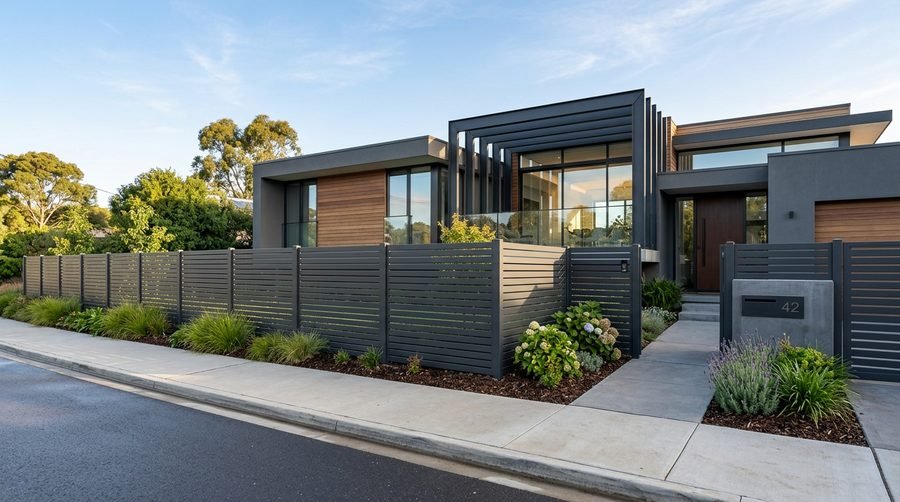
Aluminium slat fencing is the most architecturally resolved contemporary fencing option — clean lines, consistent finish, and a profile that suits modern Queensland homes with a precision that timber and Colorbond rarely achieve at the same price point. Horizontal slat fencing in particular creates strong architectural lines that reference the banding of contemporary facade design. Stone & Grain specifies and installs aluminium slat systems in powder-coated finishes — charcoal, black, white and custom colours — with post systems that allow clean transitions to gates, walls and paving.
ADVANTAGESClean architectural lines — the most design-forward standard fencing option
Powder-coated aluminium is non-rusting — ideal for coastal Sunshine Coast properties
Wide range of slat profiles, spacings and orientations
Zero maintenance once installed — no painting, staining or treatment required
Lighter than steel — post footings can be smaller in most residential applications
Custom colour matching to house or landscape palette through powder coating
CONSIDERATIONSHigher cost per metre than Colorbond for equivalent privacy and height
Slat spacing for privacy must be designed — widely-spaced slats provide limited screening
Powder coating can be scratched — repair requires matching touch-up paint
Heavier profiles and longer spans require careful structural assessment
Limited to the architectural vocabulary of the contemporary home — not suited to traditional styles
WEATHERING STEEL · FLAT SHEET · PERFORATED SHEET · LASER CUT · BLADE FENCE · FEATURE WALL PANEL
Corten Steel
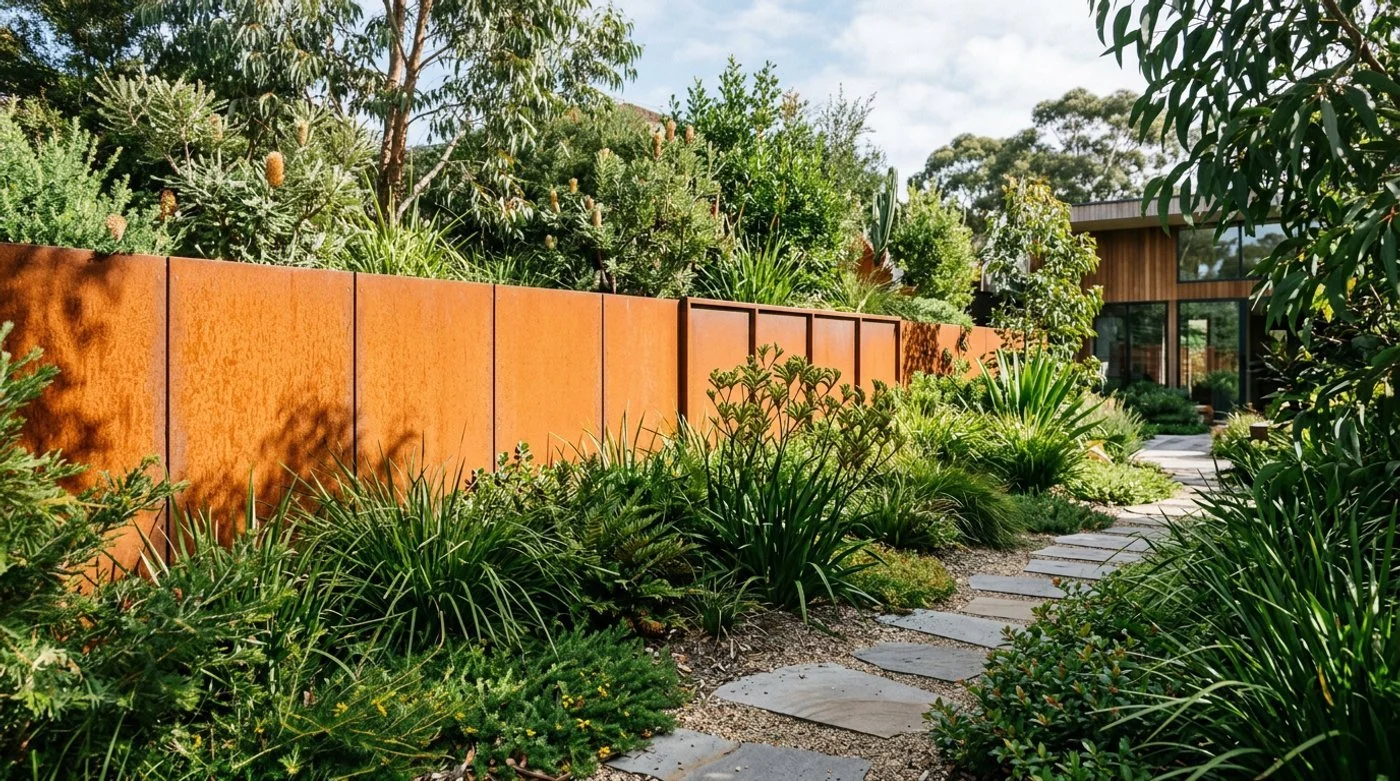
Corten — or weathering steel — is the premium material choice for clients who want fencing and screening to be a design statement. It develops a rich rust-orange patina as it weathers, stabilising into a deep, textured surface that pairs extraordinarily well with natural stone, hardwood timber and subtropical planting. Against the green of a Queensland garden, Corten provides the warm, earthy contrast that no other fencing material achieves. Once the patina has formed — typically 12–18 months in Queensland's climate — no further maintenance is required. It will not rust through. It weathers, and then it stops.
ADVANTAGESThe most premium and architecturally resolved fencing and screening material available
Rich rust-orange patina pairs beautifully with stone, timber and tropical planting
Once the patina stabilises, no maintenance is required — ever
Can be laser-cut in custom patterns — botanical, geometric, abstract
Available in flat sheet, perforated and blade profile configurations
Develops unique character specific to the site conditions and microclimate
CONSIDERATIONSDuring the weathering process (12–18 months) the steel bleeds rust onto surrounding paving — design the base detail accordingly
Not recommended within 5km of the ocean — salt air can cause uneven patina development
Heavier than aluminium — post footings must be specified for the load
Custom laser-cut panels require lead time and accurate measurements before fabrication
Higher cost than standard fencing materials — the premium is in the material and the design
PRIVACY PANEL · PICKET · SLAT · WHITE · GREY · SANDSTONE · WOODGRAIN FINISH
PVC & Vinyl Fencing
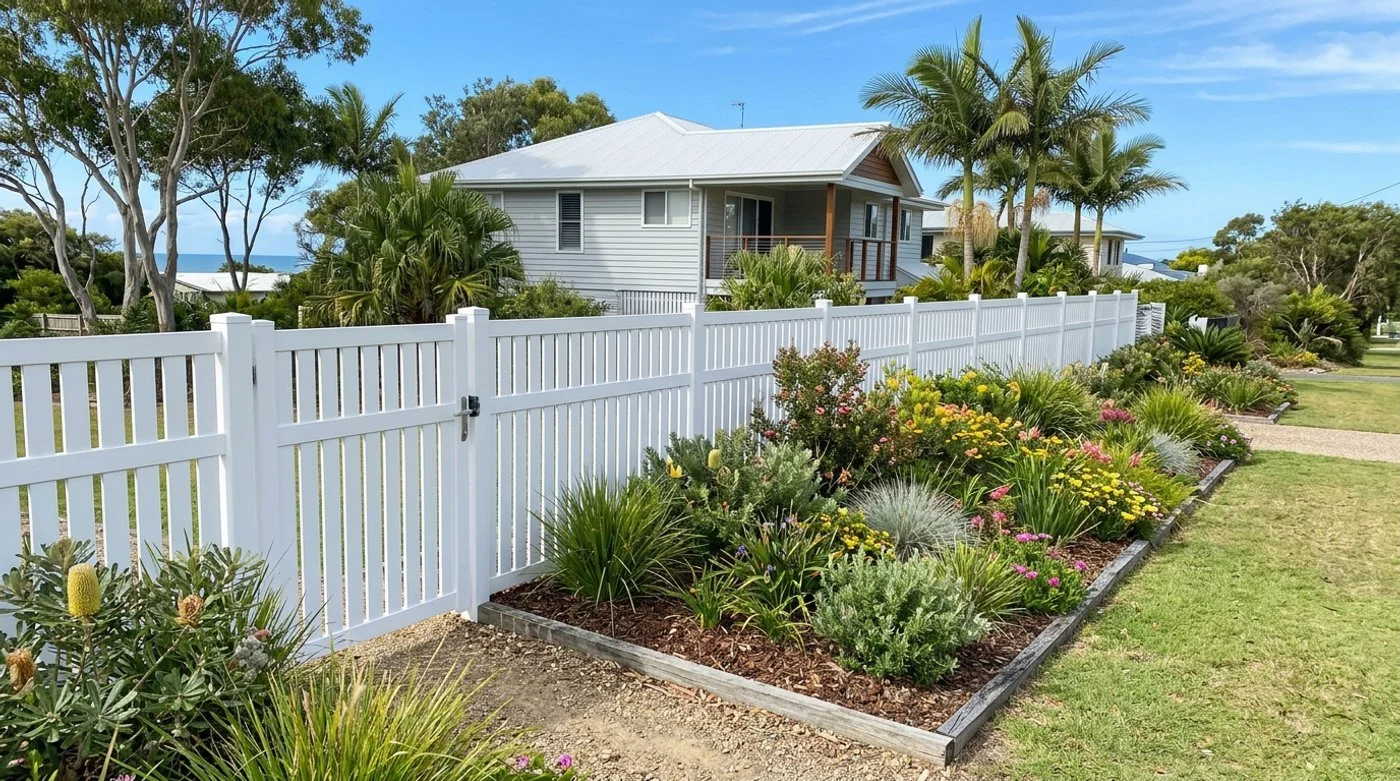
PVC fencing is the practical choice for coastal properties and clients who want a clean, maintenance-free boundary fence without the cost of aluminium slat or the upkeep of timber. It does not rust, does not rot, does not need painting, and is largely impervious to the salt air environment that degrades other materials. In white or light grey, it reads well against the coastal Queensland palette. Stone & Grain installs PVC fencing as a straightforward, durable boundary solution — without apology and without pretending it is something it is not.
ADVANTAGESCompletely maintenance-free — no painting, oiling, sealing or treatment required
Resistant to salt air, moisture and UV — ideal for coastal Sunshine Coast properties
Does not rust, rot or corrode in any typical residential environment
Clean, consistent appearance throughout its service life
Cost-effective for longer boundary fence runs
Available in woodgrain finishes that approximate the look of timber
CONSIDERATIONSReads as a manufactured product — lacks the warmth or character of natural materials
Can discolour (yellowing) over long periods in direct UV — quality of product matters
Less structural rigidity than steel or hardwood — span limits must be observed
Damaged panels require replacement — cannot be repaired as easily as timber
Limited colour range compared to powder-coated aluminium
FRAMELESS · SEMI-FRAMELESS · POOL FENCING · BALUSTRADE · WIND SCREEN · TOUGHENED SAFETY GLASS
Glass Fencing & Screens
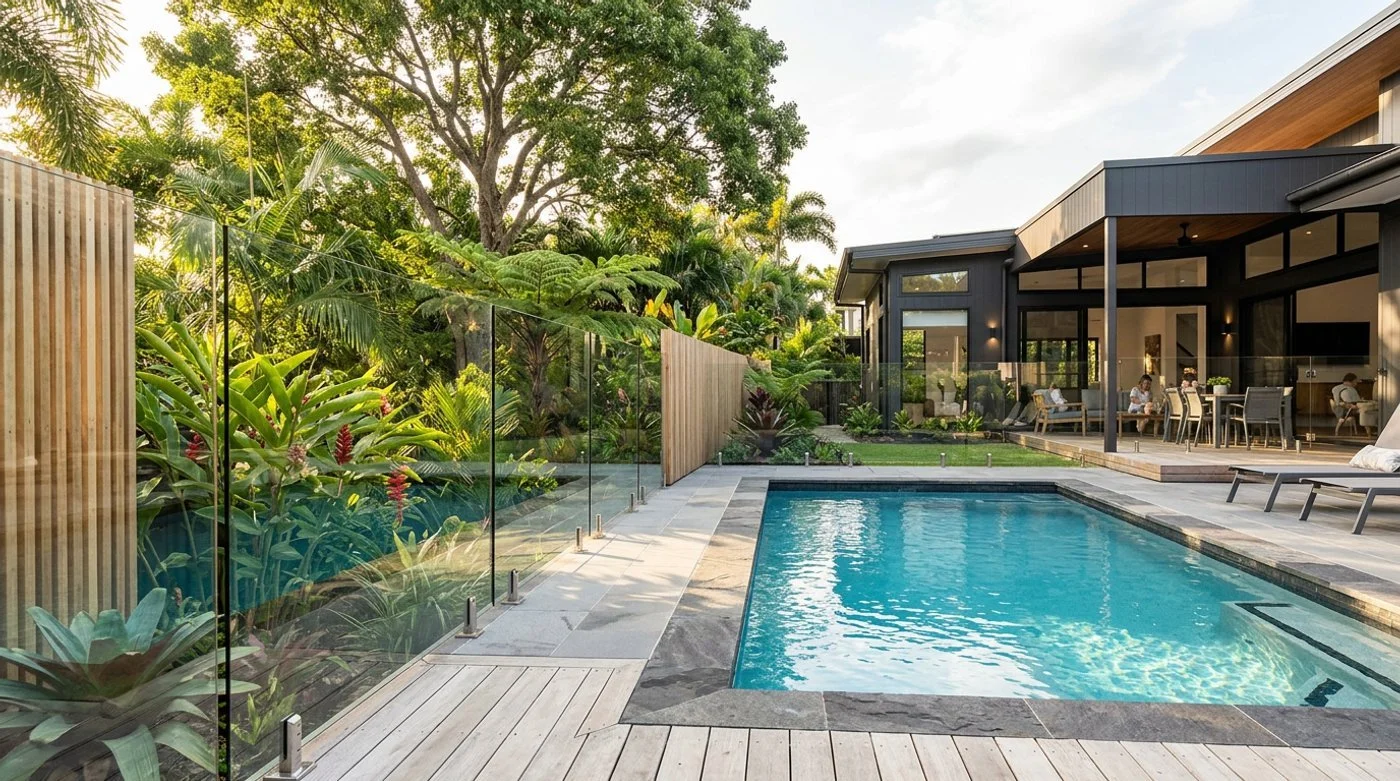
Glass fencing is the right answer when the view is worth preserving. For pool enclosures where the landscape beyond the pool is part of the experience, for elevated decks where the outlook is the point, for wind screens on exposed sites where visual connection to the surroundings must be maintained — toughened glass provides the structural performance of a fence with none of the visual interruption. All glass fencing is toughened safety glass and installed to AS 1926.1 pool safety standards where applicable.
ADVANTAGESPreserves views completely — the most visually unobtrusive fencing option
Frameless glass achieves a premium, architectural quality
Suitable for pool enclosures, deck balustrades and wind screens
Low maintenance — clean glass panels with standard glass cleaner
Toughened safety glass provides structural performance for balustrade applications
Can be combined with aluminium, timber or Corten frames for hybrid systems
CONSIDERATIONSGlass panels accumulate dust, water marks and fingerprints — require regular cleaning
Spigots and fixings must be specified for the pool chemical environment where applicable
Pool safety gate hardware must be self-closing and self-latching — specify and maintain
Not appropriate as a boundary fence — panels are vulnerable to impact in exposed locations
Wind exposure can cause vibration and noise in frameless panel systems
GATES & AUTOMATIONThe gate is the punctuation of the fence.
Every fence needs a gate — and the gate is the point where the fence becomes a design element rather than a boundary marker. Stone & Grain builds gates in matching or contrasting materials to the fence, with frames and hardware specified for the weight, frequency of use and aesthetic direction of the project.
For driveways and high-use pedestrian entries, automated gate systems add convenience and security. Stone & Grain coordinates gate automation — motor selection, access control, intercom and keypad systems — as part of the fence and gate build, not as a separate subcontract that arrives after everything else is finished.
SLIDING GATES
Space-efficient for tight sites — the gate runs along the fence line rather than swinging out. Requires clear run distance along the fence. Suited to driveways where a swing gate would impede traffic flow.
SWING GATES
Single or double leaf, inward or outward opening. Simpler mechanism than sliding, lower cost, well-suited to pedestrian gates and lower-frequency vehicle entries. Post specification must account for the swing gate load.
AUTOMATED SYSTEMS
DC motor systems for both sliding and swing gates. Remote control, keypad, intercom and smart home integration options. Stone & Grain coordinates a licensed electrician for all automation wiring.
PEDESTRIAN GATES
Matching or feature pedestrian entry gates beside driveway gates, or as standalone garden entries. Hardware selected for frequency of use and material — stainless steel hardware for coastal, powdercoated for inland sites.
What you need to know before building a fence in Queensland.
Fencing in Queensland is governed by a combination of local government planning requirements and state legislation. Stone & Grain advises on compliance before any fence is designed and coordinates any necessary approvals where required.
REGULATIONS & COMPLIANCE
HEIGHT LIMITSMost residential fences must not exceed 2 metres in height without council approval. Front boundary fences — between the property and the street — typically have lower limits of 1–1.2 metres, depending on the local government area.
POOL FENCINGAll pool enclosure fencing must comply with Queensland Development Code MP3.4 and Australian Standard AS 1926.1. Gate self-latching hardware, correct panel heights and compliant footings are mandatory. All Stone & Grain pool fencing installations are certified to this standard.
DIVIDING FENCESThe Neighbourhood Disputes (Dividing Fences and Trees) Act 2011 governs dividing fences between neighbouring properties. Written notice to the adjoining owner is required before construction. Stone & Grain can advise on the process.
QBCC LICENCE COVERAGEFencing constructed as part of a broader residential landscaping project is covered under Stone & Grain's QBCC Residential Low Rise Builder licence (15249701). Standalone fencing is covered under the same licence where the fence is a structural element of the property.
Ready to define your boundary?
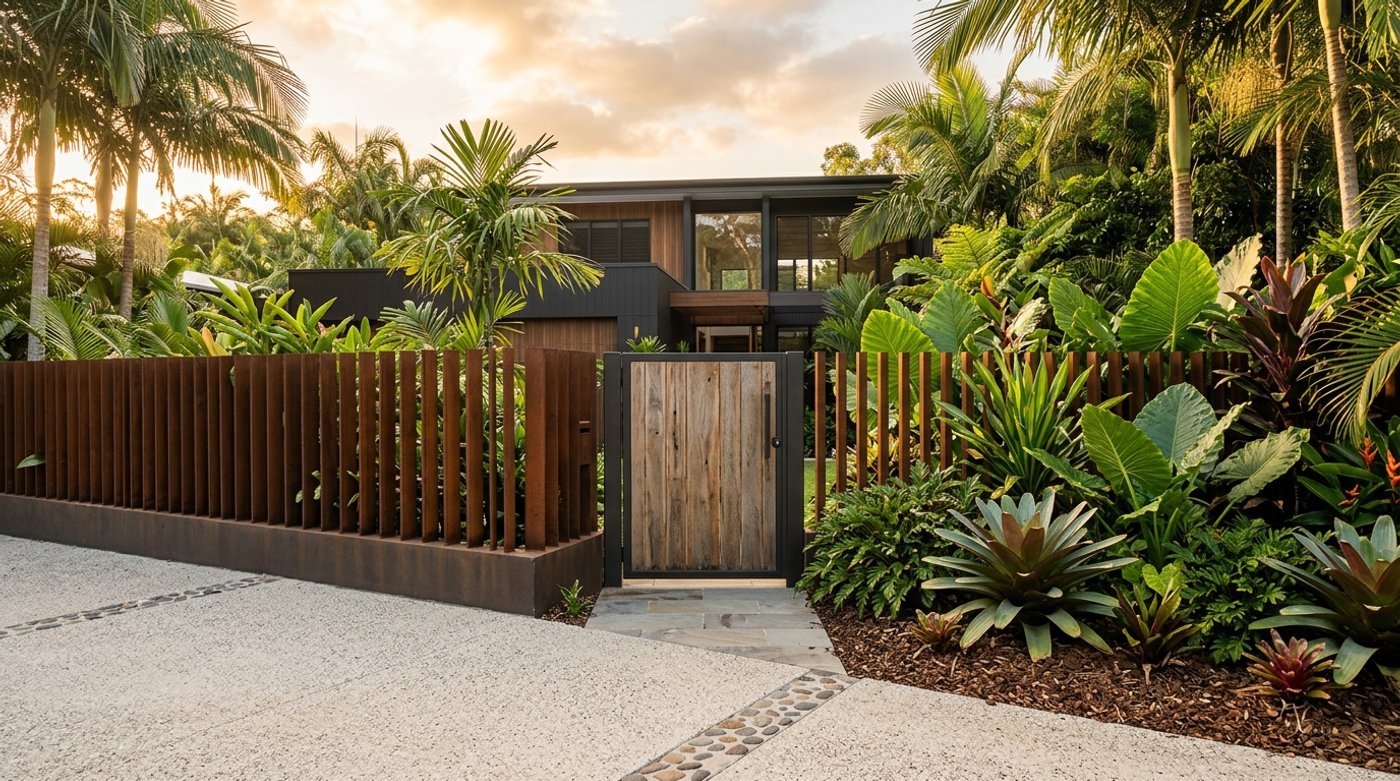
Fencing is most effective when it is designed alongside the landscape rather than added to it afterwards. Stone & Grain integrates fencing and gates into every outdoor environment build — coordinated in material, level and detail with everything around it.
Frequently asked questions
-
It depends on how close you are to the coast. Within a few kilometres of the ocean, PVC and Colorbond Ultra (marine-grade) are the practical choices — near-zero maintenance and unbothered by salt air. Aluminium slat also holds up well near the coast since powder-coated aluminium doesn't rust. Corten steel is a striking design feature but isn't recommended within about 5km of the ocean, as salt air causes the patina to develop unevenly. Further inland, hardwood timber and Corten both perform well and bring warmth manufactured materials can't match.
-
Most Queensland councils allow side and rear boundary fences up to 2 metres without formal development approval, while front boundary fences are typically limited to around 1–1.2 metres if solid (higher if at least 50% see-through). These limits vary by local council planning scheme, so we confirm the specific rule for your property before finalising a design.
-
Under the Neighbourhood Disputes (Dividing Fences and Trees) Act 2011 (Qld), adjoining owners are generally equally responsible for a "sufficient" dividing fence — a standard fence appropriate to the area. If one owner wants something more expensive, like Corten steel instead of a standard timber paling fence, they typically cover the difference above the standard quote unless the neighbour agrees otherwise.
-
Neither is objectively better — they suit different jobs. Colorbond (Ultra grade on coastal properties) is the lowest-maintenance, most cost-effective option for long runs and very durable, but it reads as a manufactured product. Timber brings warmth and character no steel or aluminium product replicates, but needs an oiling schedule and will show more wear over time. We're upfront about that trade-off rather than pushing one material.
-
In Queensland's climate, Corten typically takes 12–18 months to develop a stable rust-orange patina. During that period it will bleed some rust onto surrounding paving, so the base detail needs to be designed for it. Once stabilised, no further maintenance is required — it won't rust through. We don't recommend Corten within about 5km of the ocean, as salt air causes uneven patina development.
-
Queensland pool safety laws require a compliant, non-climbable barrier around the pool area, generally a minimum 1200mm high, with self-closing and self-latching gates. Frameless and semi-frameless glass fencing is a popular compliant option because it doesn't block the view, but it must meet AS 1926.1. We handle the compliance side as part of any pool fencing job, including the pool safety certificate process.
-
Yes — sliding and swing gate automation, integrated with the fence design rather than bolted on afterwards. We coordinate the electrical work motorised gates need and specify hardware to suit coastal or inland conditions, since salt air is hard on cheap gate hardware.
-
Yes. Stone & Grain Co holds a QBCC Residential Low Rise Builder Licence (No. 15249701), which covers fencing as part of broader residential building and landscaping work — so council and building compliance is handled as part of the job, not left for you to sort out separately.